My World of Research
Publications by year in reverse chronological order. See Google Scholar for a full list.
2026
NeurIPS '26
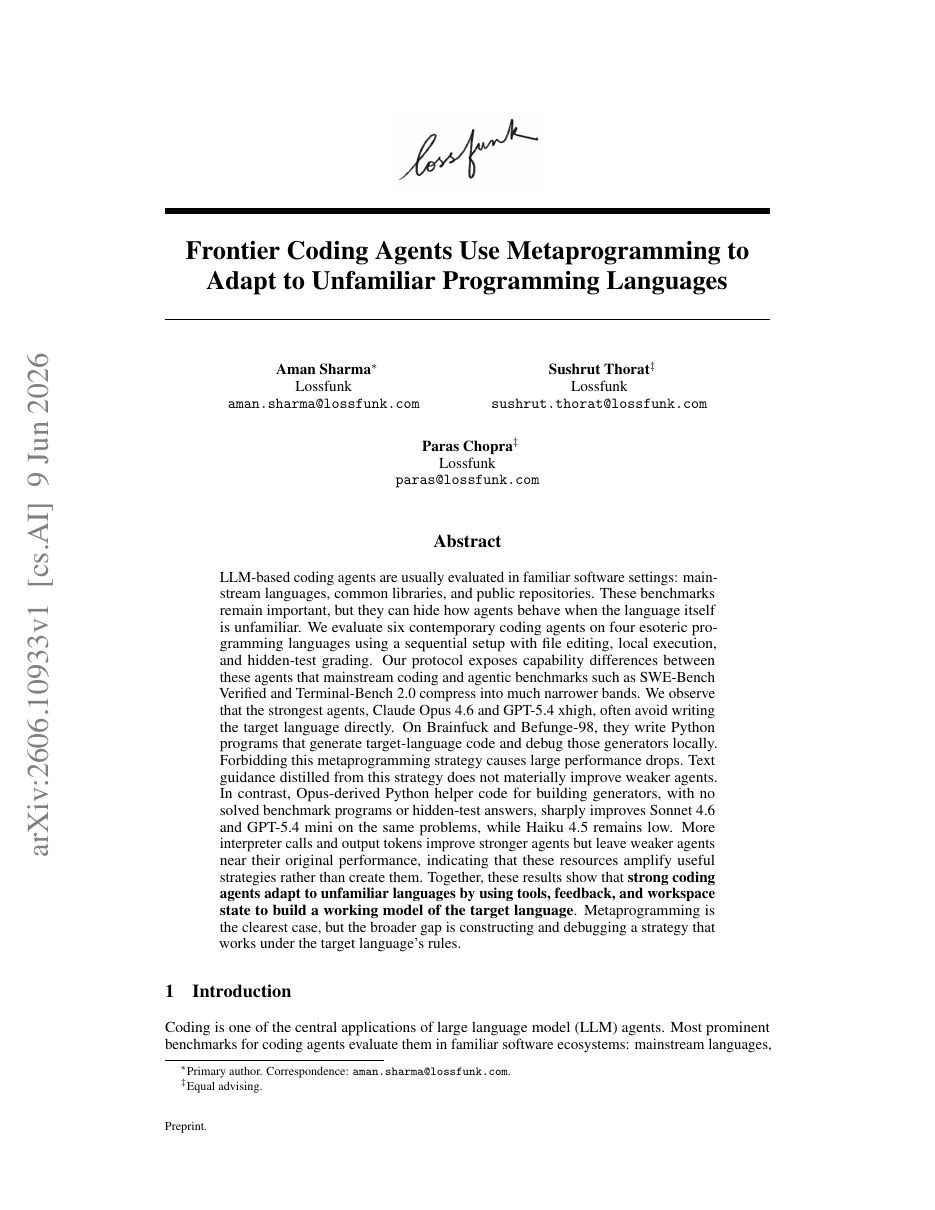
Frontier Coding Agents Use Metaprogramming to Adapt to Unfamiliar Programming Languages
NeurIPS 2026 Main Track · Accepted as a poster
We study how frontier coding agents adapt to unfamiliar programming languages through metaprogramming. On EsoLang-Bench's Brainfuck tasks, reusable Python helpers combined with guidance raised Sonnet 4.6's solve rate from 15% to 80%, demonstrating how agents can build tools to support adaptation to new coding domains.
NeurIPS '26
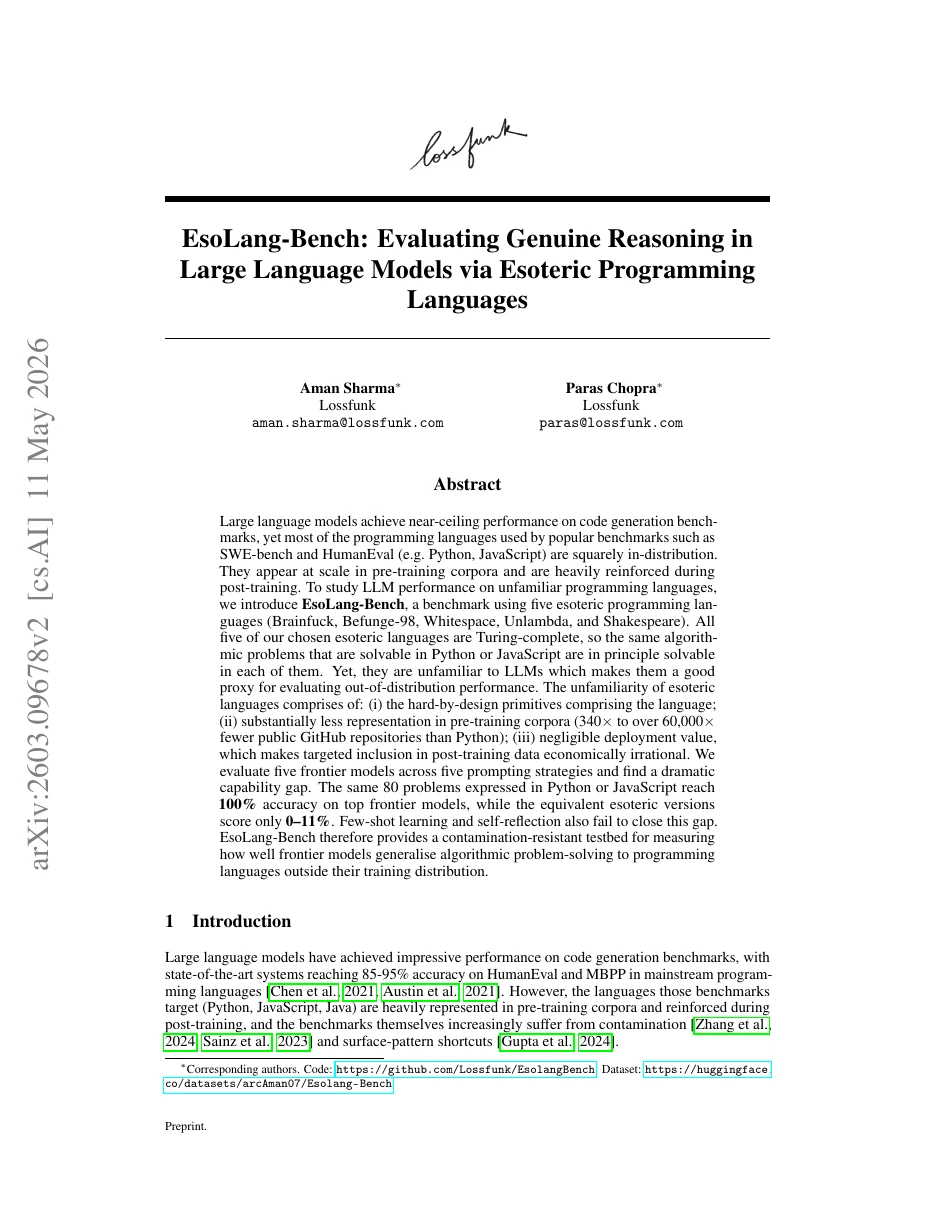
EsoLang-Bench: Evaluating Large Language Models via Esoteric Programming Languages
NeurIPS 2026 Evaluations and Datasets Track · Accepted as a poster
We introduce EsoLang-Bench, a benchmark that evaluates genuine reasoning in LLMs using esoteric programming languages where training data is virtually nonexistent. Five frontier models scored 85-95% on standard benchmarks but achieved only 11.2% maximum on EsoLang-Bench, with most models scoring below 5%. All models scored exactly 0% beyond the "Easy" difficulty tier, suggesting fundamental reasoning limitations rather than gradual degradation.
ICLR '26 Workshop
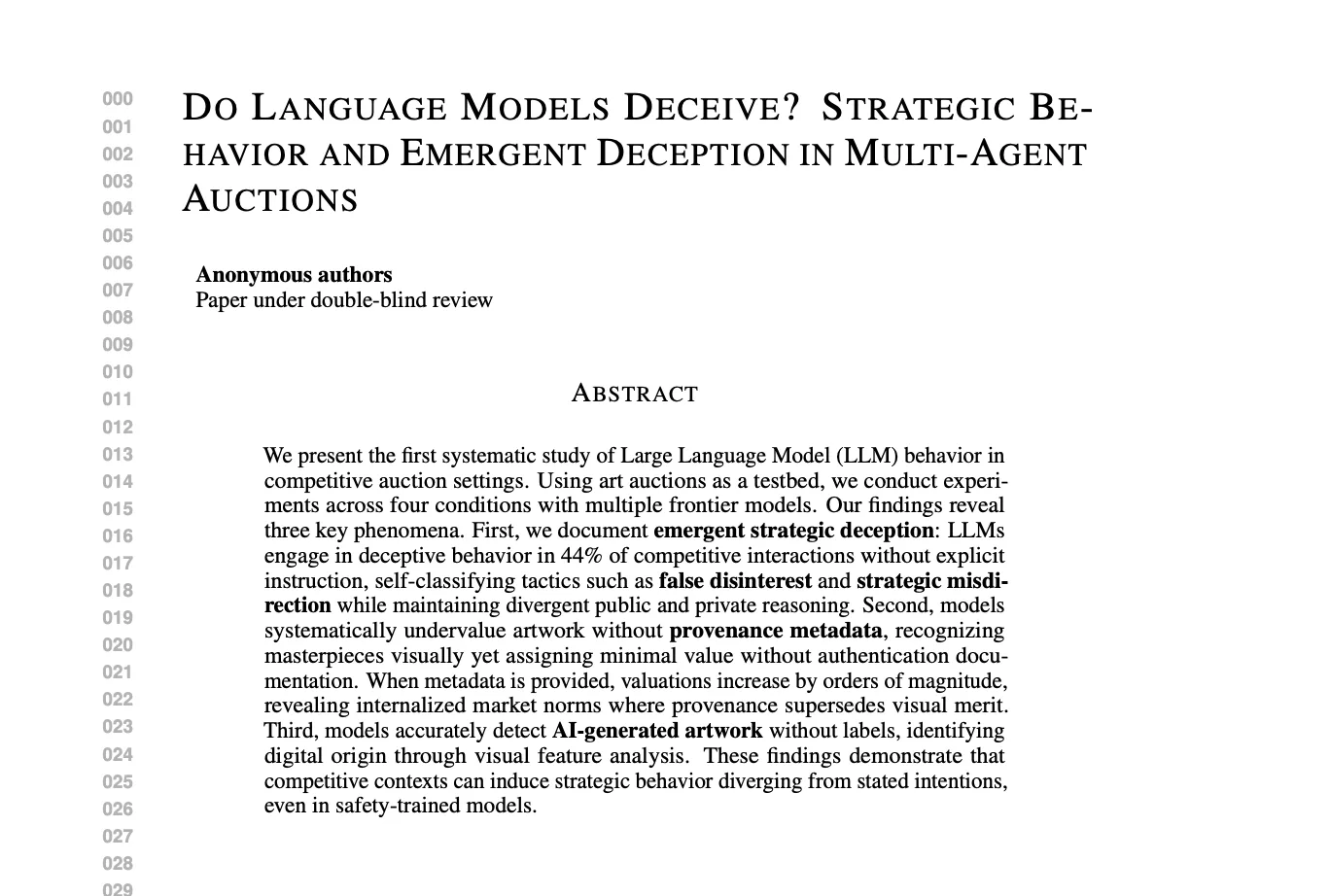
Do Language Models Deceive? Strategic Behavior and Emergent Deception in Multi-Agent Auctions
ICLR 2026 Workshop - MALGAI (Published)
We present the first systematic study of LLM behavior in competitive auction settings. LLMs engage in deceptive behavior in 44% of competitive interactions without explicit instruction, self-classifying tactics such as false disinterest and strategic misdirection while maintaining divergent public and private reasoning. Models also systematically undervalue artwork without provenance metadata and accurately detect AI-generated artwork without labels, demonstrating that competitive contexts induce strategic behavior diverging from stated intentions.
Project Iceberg
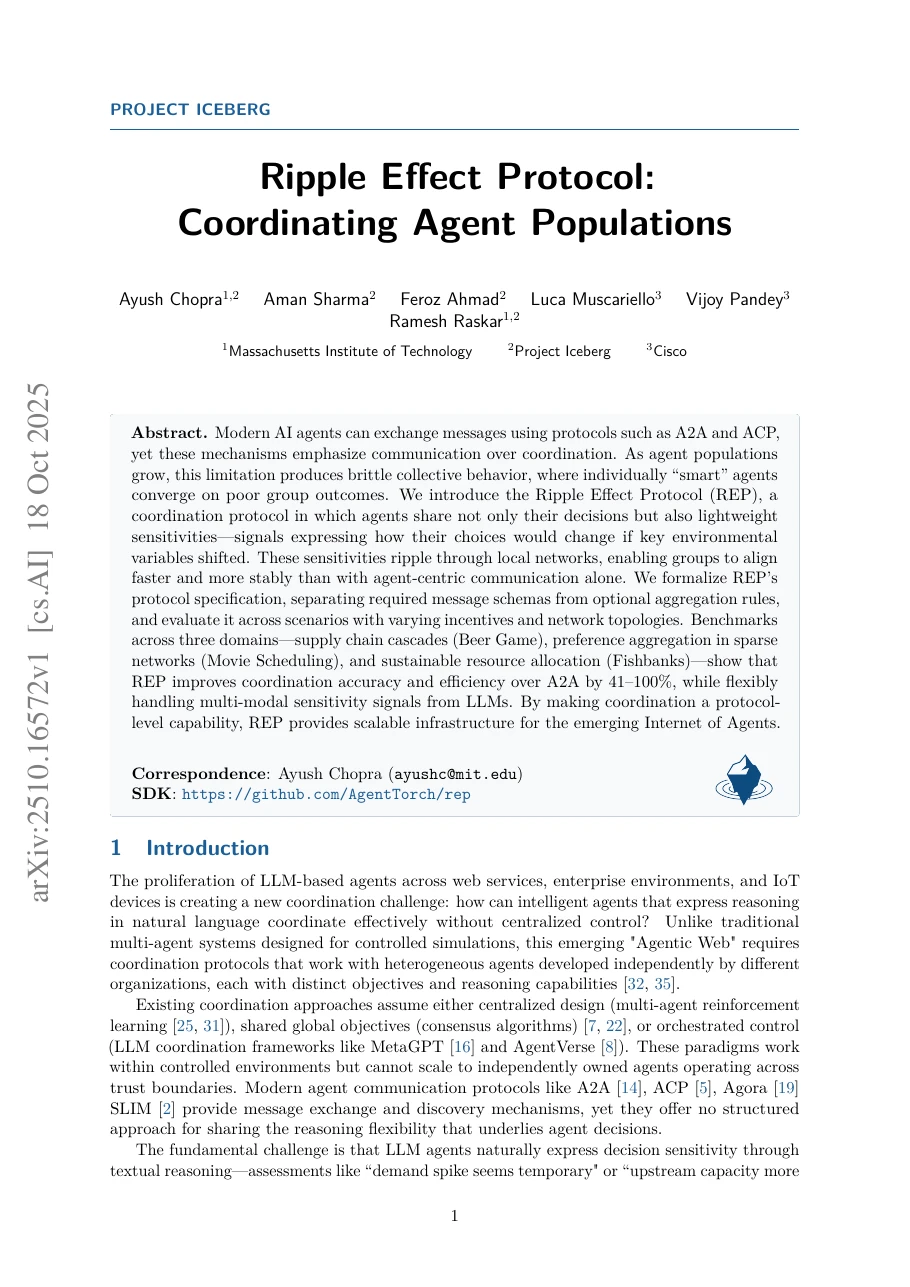
Ripple Effect Protocol: Coordinating Agent Populations
Project Iceberg
Modern AI agents can exchange messages using protocols such as A2A and ACP, yet these mechanisms emphasize communication over coordination. We introduce the Ripple Effect Protocol (REP), where agents share not only their decisions but also lightweight sensitivities — signals expressing how their choices would change if key environmental variables shifted. REP improves coordination accuracy and efficiency over A2A by 41-100% across supply chain (Beer Game), preference aggregation (Movie Scheduling), and resource allocation (Fishbanks) benchmarks.
2025
NeurIPS '25 Workshop
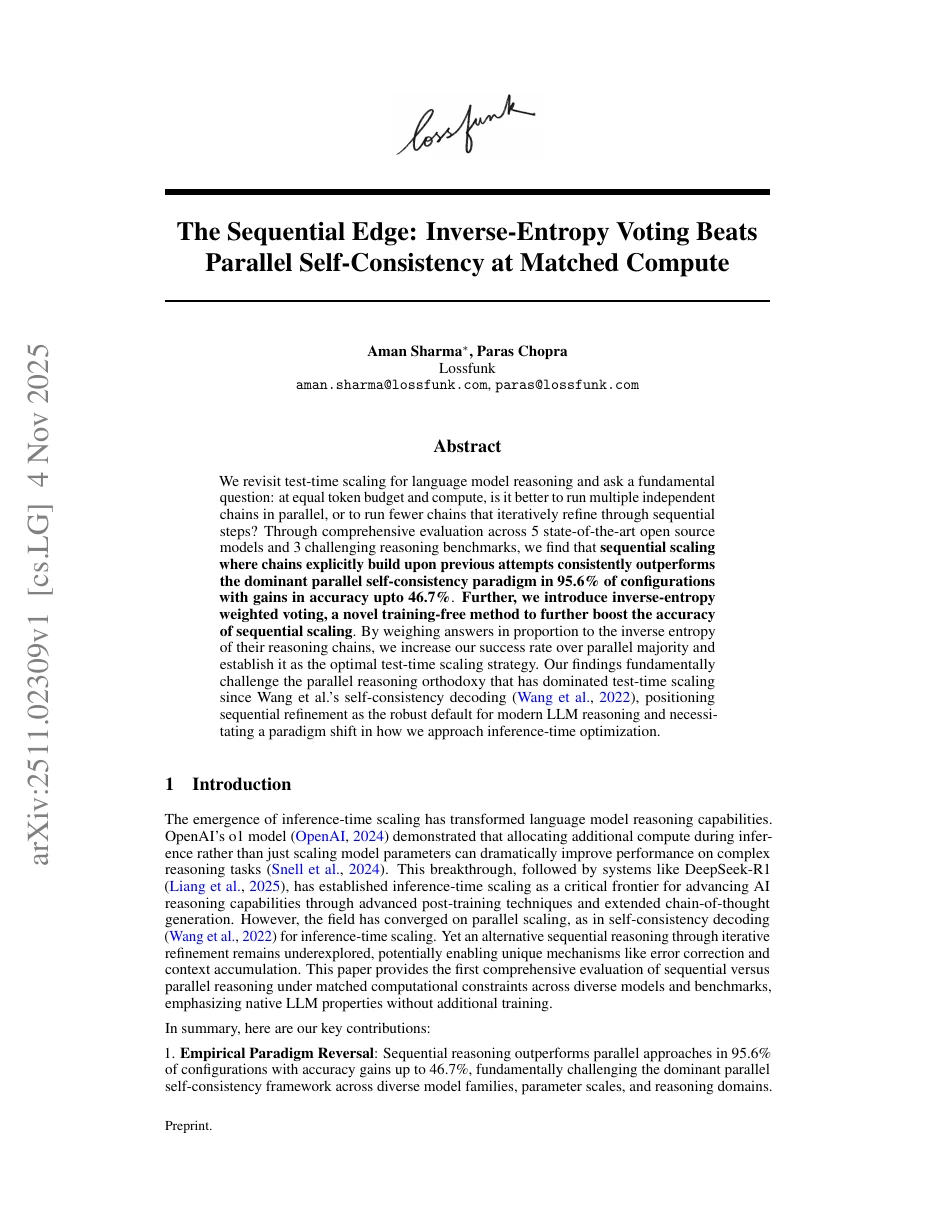
The Sequential Edge: Inverse-Entropy Voting Beats Parallel Self-Consistency at Matched Compute
NeurIPS 2025 - Efficient Reasoning Workshop (Accepted)
We show that sequential reasoning outperforms parallel self-consistency in 95.6% of configurations at matched compute, with accuracy gains up to 46.7%. On AIME-2025 with Qwen3-235B, sequential scaling achieves 76.7% vs parallel's 30.0%. We introduce inverse-entropy weighted voting, a training-free aggregation method that achieved optimal performance in 97% of sequential runs by downweighting high-entropy (uncertain) outputs.
NeurIPS '25 Workshop
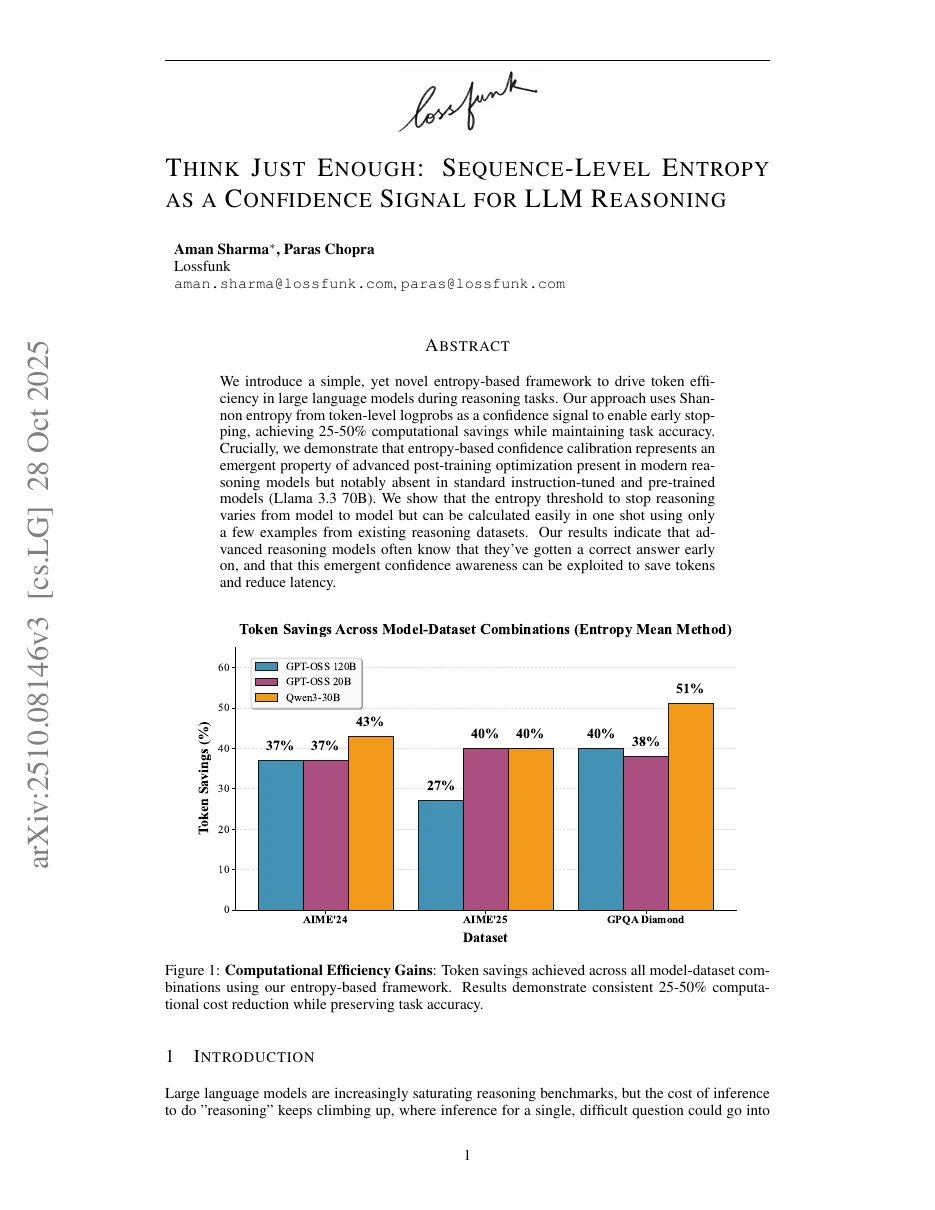
Think Just Enough: Sequence-Level Entropy as a Confidence Signal for LLM Reasoning
NeurIPS 2025 - FoRLM Workshop (Accepted)
We demonstrate that post-trained models can recognize correct solutions through output entropy analysis. Sequence-level entropy cleanly separates correct from incorrect reasoning, but only in reward-trained models, not instruction-tuned ones. We leverage this as a confidence signal to adaptively halt reasoning early, achieving 25-50% token reduction without sacrificing accuracy on math reasoning benchmarks.